


Express Delivery Available
View delivery information

5 Star Rated
On Google & TrustPilot
Handmade in the UK
From the finest materials
Shaker style, tongue and groove, wainscot, v-groove… It can admittedly be a bit of a headache working out which types of panelling are right for you.
You might see a house with gorgeous walls and think ‘I want that type of panelling’, without knowing what exactly ‘that type’ is. We completely get it – there are a lot of terms that mean pretty similar things for wall panelling.
That’s why we’ve put together this guide so you can easily compare common wall panelling styles and work out which ones are best for your home. So, if you’re ready to turn your wall panel ideas into a reality, see below for a breakdown of the top types.

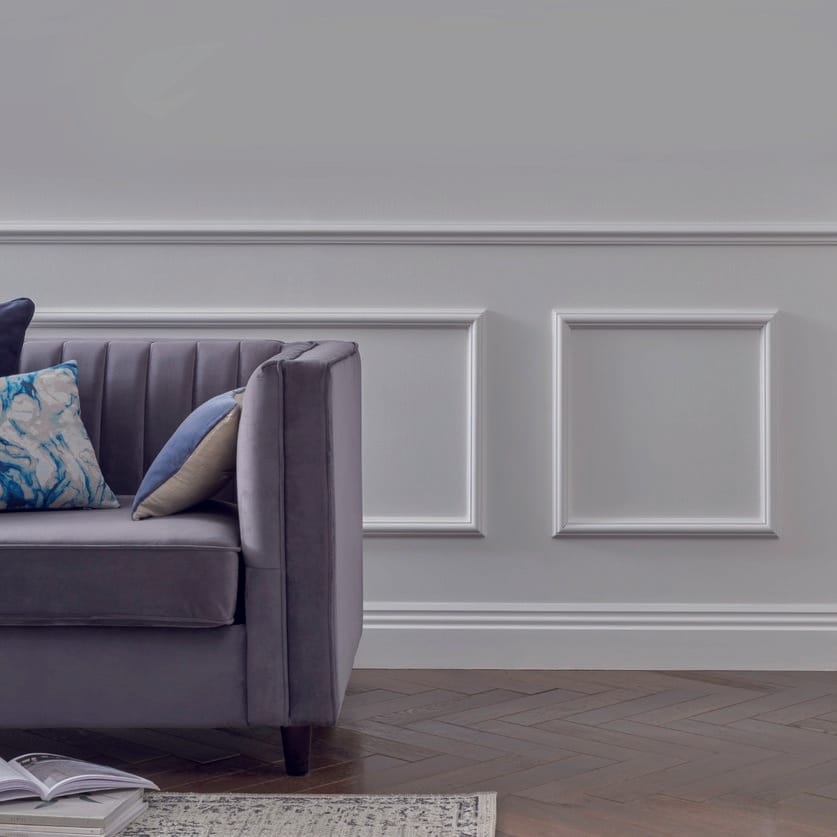
A traditional type of wall panelling, wainscoting is one of the most popular styles. It’s known for its resilience to scuffs, making it ideal for high-traffic areas like staircases and cloakrooms.
It’s created through decorative mouldings in rectangle or square frames, using thin strips to achieve the look. Especially when pre-cut, it’s simple to install, and we have a step-by-step guide to panelling walls to make the process even easier.
And, to replicate the style in the above picture, try our Regal Wainscoting Wall Panelling.

For a classic square formation of panels, try ones in a shaker style. This is another popular type of wall panelling, adding understated detailing to rooms in a traditional style.
It’s sometimes referred to as board and batten, although the two styles are slightly different. Essentially, shaker style panels generally use square or rectangle frames. Board and batten panelling, on the other hand, tends to have more defined vertical lines.
We’ve focused on shaker style here but, ultimately, it’s a case of displaying MDF wall panelling strips in the style that best suits the room.
For cut-to-size shaker style panels, try our made-to-measure wall panelling creator. Simply input the measurements of your wall and receive an instant quote for a panelling kit that’s pre-primed and ready to be installed.

Slat wall panelling is a modern interpretation of what was originally a traditional style. It involves lots of thin, vertical panels, usually extending across the full height of a wall.
It can be created using MDF slat wall panels or wood beading.
If you choose to use wood to create a slat wall, you can wax or stain it for a natural look, or paint MDF panels to your desired colour.

Tongue and groove is one of the most popular MDF wall panel styles. It creates vertical panelling and is often used for half-wall designs.
One option is to get beaded tongue and groove panels for added texture. This introduces subtle detailing between each panel and avoids heavy shadows.
Or, if you’re looking for strong definition between the panels, look for v-groove panelling.
It creates a cosy, farm cottage style design. And, as it is a relatively simple design, it’s ideal in rooms like boot rooms and kitchens where you want pretty but unfussy panelling.
Keen to decorate your bathroom? Shiplap tongue and groove panels are a good option. They’re moisture resistant, letting you add a touch of sophistication to the room without needing to worry about them getting damaged by humidity.

This playful modern style involves creating geometric shapes on walls using panels or beading.
3D effect panels are great for geometric panelling. You can buy them in patterns like chevrons or tiles to create fun, vibrant designs on the walls.
You can also put your own twist on this style by designing a pattern with MDF panels and playing with negative space. To keep the look contemporary, we suggest painting the panelling and wall in the same colour for a sleek finish.

One of our favourite media wall ideas is adding ribbed panelling within shelving units for subtle decoration. When painted in the same colour as the rest of the wall, they create an interesting backdrop with soft, delicate shadows.
The example in the above photo was installed by Get That Covered using ribbed panels from Panelling Direct.
You can get ribbed panels in a range of sizes. We suggest opting for thinner ones for media walls to avoid them being overpowering.
However, if you’re planning to add ribbed panels to a bigger space, such as the full height of a wall, you might want to consider wider ones. See our full range of ribbed wall panels to compare different sizes.
Now you’re familiar with the different types of panelling, have a look through our favourite wall panel ideas for more DIY inspiration.


